by Alethea Hartwell | Sep 29, 2026

Hartwell creates suspense in a pre-World War setting.
Operation Excalibur, a new work of historical fiction by Alethea Hartwell, tells the story of Rudolf Diesel, inventor of the diesel engine. The book examines the mystery surrounding Diesel’s death. Although Diesel was reported to have died by suicide, Hartwell offers another possibility—one that turns a familiar historical conclusion into an enjoyable narrative of suspense and intrigue.
The novel’s voice is clear and easy to read. The reader understands complex ideas without losing interest in the storyline. Hartwell’s research and attention to historical details create a vivid portrait of time and place. The reader experiences the settings and ambiance of bygone days along with the heart-pounding realities of pre-World War I Europe.
Rudolf Diesel pulls the reader into a bygone era.
Hartwell creates an interesting character in Rudolf Diesel. She portrays him as a thoughtful, compassionate, and unusual man with deeply held beliefs about how life should be lived. Diesel knew and befriended many historical figures, and Hartwell does not shy from including them in the book. These were captains of industry and invention. Hartwell gives us a fresh perspective without hammering the reader on the perceived ills of past practices. Hartwell also makes clear where the demands of fiction have required changes to facts, dates, or chronology; a welcome consideration for readers who value both imagination and historical accuracy.
Taking place just before World War I, Operation Excalibur explores an era less frequently portrayed than the familiar landscape of World War II fiction. That choice gives the novel a distinctive atmosphere and opens a window onto a world poised at the edge of enormous change.
The book’s sensory descriptions highlight the novel. The reader feels the rain, smells the air, sees the sidewalk, walks beneath the lights, and hears the rumble of trains along the platforms. We stand at the ship’s prow, enter the lecture hall, and rise in a balloon. These are not merely backgrounds for the action; they are places we inhabit. Hartwell’s writing grants the reader a repast in history and, for a time, we are truly there.
For readers who enjoy immersive historical fiction, real-life mysteries, and richly drawn characters, Operation Excalibur is a rewarding offering.
(A.I. assisted in drafting the review, but the ideas and reading were all mine, along with the final draft. Thanks for reading. B.A. Coots)
Alethea’s book is available directly from aletheahartwell.com
by Bev | May 27, 2025

In Search of the Hidden Moon is Tim Eichenbrenner’s second novel. The book takes the reader on a well-crafted hunt for right living through Christ even as the reader plunges into the darkness of human trafficking, failed marriages, failed parenting, and aging in America. Notwithstanding these lofty topics, the book maintains a humane tone, never overloading the reader with preach and teach dialogue, or mini sermons in case the reader doesn’t get the point. None of that. Instead, the voice is conversational and comfortable, so much so that I was sad to be at the end.
The protagonist, Gil, is a doctor, but don’t let that stop a reader. Medical terminology is used in context and easy to follow and Gil is full of life and full of flaws. In short, he is easy to spend time with, as is his love interest, Alex. They navigate waters of relationships with charm and even grace. These two are engaging friends to the reader by the end of the book.
The central plot is a wonderfully readable tangle that starts with an explosion, fire and dying man’s injunction to “find the girls.” Mixed in are minor plots of finding a unknown brother, second chances from a lackluster father, and a cheating husband, along with a very pastoral pastor. And dogs, did I mention dogs? Oh my, put a good canine in a book and I’m sunk and this book has several magnificent beasts.
Read this book to make new friends, human and canine. Read this book for the great examples of forgiveness. Read it for the grace of the characters and the struggle for all of us living in this worldly world when our home is not of this world.
Thank you, Tim Eichenbrenner for a great read. Find Tim at timeichenbrenner.com. He posts Tuesdays Thoughts on -wait for it- every other Tuesday. You’ll also find information on his first book, To Live in the Light: A Life Renewed, a Faith Restored.
by Bev | Mar 16, 2022
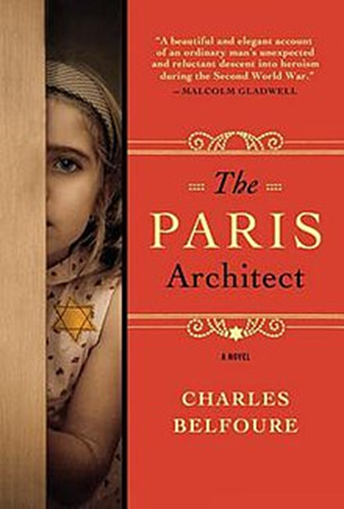
The Paris Architect, by Charles Belfoure is set at the time of World War II in occupied Paris. The main character, Lucien Bernard, is an architect in desperate need of work. Lucien is on his way to interview for a position with a wealthy industrialist Auguste Manet. Manet is building munitions factories and plants for the Reich.
In the opening scene of the book a German Officer shoots a Jew on the streets of Paris. Lucien is so close that the blood spatter from the shot gets on Lucien’s only good suit. The reader doesn’t know what branch of service the German officer serves only that his uniform is green and black.
The Paris Architect, teaches the reader in the first pages of the book. The reader learns that the German soldiers are ruthless but polite, Lucien has little or no concern for the fate of the Jews, Lucien cares more about his clothes than the dead man, and he cares more about presenting a calm confident air to Manet.
The opening is startling, brutal, and plays fair with the reader and the main character of the book. It is a satisfying opening and the reader is prepared for violence and the upside-down world of politeness in the face of evil.
In subsequent chapters Lucien is hired to work on the design and construction of munitions factories for the Reich only after agreeing to design hiding places in plain sight for refugee Jews. Both of these out of synch requests come from the wealthy industrialist Auguste Manet.
The premise that a great industrialist with such talented carpenters, draftsmen, and builders at his disposal should bother with an architect for his plans to hide Jews didn't ring true. The construction technicalities of that effort were never developed and might have been used to deepen the characterizations as well as make more believable and intense that narrative. The noise, the deconstruction and reconstruction, getting supplies into buildings and debris out of buildings right under the Reich's nose, all of this would have gone a long way to making this a strong re-readable novel for many readers.
Belfoure’s field of study is architecture and real estate with a specialty in historic preservation. Belfoure studied the Priest Holes of 16th century England and began thinking of a plot which became The Paris Architect. The priest Holes of England are a fascinating study and would have made a remarkable work of historical fiction. In translating the circumstances of England’s hiding holes to Paris during the Occupation, Belfoure loses depth and character. He trades a real situation for an inserted fiction. He also trades the real character of the carpenter Owen, for the shallow fictitious character of Lucien. Finally, Belfoure also trades a lesser understood setting with wonderful pathways for fictionalization for a setting with choices that are too easy and simplistic for heightening tension and plot. Belfoure makes little attempt at showing us the actual hiding places, how they are built, who is in on it. Being with Lucien as he sees his piano hinge going into place and the difficulties of actually fitting that hinge would have made for strong characterization of Lucien. Belfoure adequately explains that Lucien wants little or nothing to do with the actual construction, but it leaves a false ring in the explanation's wake. The hiding places of The Paris Architect magically appear by magical carpenters within hours of receiving a set of drawings that equally only took hours to prepare. The lack of details left the book sagging a bit in the middle and Lucien’s character flat. To read an alternate point of view read Ar. John McLean’s in depth and thoughtful review. https://johnmcleanarchitect.com/the-paris-architect.htm.
The book takes a nice turn in the end when Lucien connects with Bette and adopts Pierre. The final scenes were satisfying, and Lucien finally grew into an ethical character. Major Dieter Herzog is a minor character with an important role in the book. His character was well rounded and after finishing the book, it is worth effort to revisit the scenes he occupies.
Read this book for a satisfying fast paced read of WWII fiction. Read it for the transformation of Lucien in the end and read it for the minor characters of Dieter Herzog and Pierre. Thanks for reading.
by Bev | Mar 14, 2022
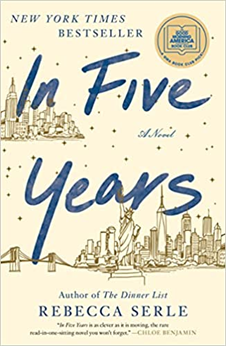
The back cover of this book reads, “an unforgettable love story, but it is not the one you’re expecting.” The book blurb plays fair with the reader. In Five Years isn’t a romance by any stretch of the imagination. This book covers a friendship as a love story. Serle develops two female characters who lean on each other from their grade-school days and struggle through professional and personal griefs and triumphs. Serle’s evocation of the friendship between Dannie and Bella is one of the reasons to read this book.
In Five Years begins with a perfect couple planning their perfect life in a completely predictable manner. David and Dannie are settled and happy. They are not in love, but they love each other. In fact, Dannie, in the first pages of the book, is charmingly well organized and analytic and supremely unconcerned about the goo of relationships. She is a colorful mix of the Big Bang Theory’s Sheldon and Joan Hickson’s rendition of Miss Marple. Dannie is not much for emotions, unlike her best friend Bella. Dannie is all about work, schedules and doing what’s next in her plan. She presumes that her mate David is on the same path and equally comfortable. By the end of Chapter two, Dannie and David are engaged and celebrating. Bella is in the loop cheering Dannie on.
In chapter three, Dannie has a short dream/prophetic vision and the book changes course. The reader is supposed to take the prophetic vision seriously, but it is a difficult jump. The book is clearly not science fiction or fantasy fiction, so this prophetic vision never quite seats itself. Instead, the main character becomes an unreliable narrator. The switch to suspended realism in an otherwise down-to-earth book and with a particularly down-to-earth main character upends the groundwork already laid by the author in the first two chapters. The reader no longer knows how to read the book. To complicate matters, down-to-earth Dannie becomes a ‘hot mess.’ Remarkably she still performs her work to her very high standards even while her world is upside down.
Without spoiling the book for those who haven’t read it, the ending seems less real than the vision. It was set forth to solve the mystery of the vision with little heed to the characters.
The book is a quick read and the plot twists and turns in ways that keep the reader reading. It is not a book to return to, but the mystery is satisfied and the open ending works.
Read In Five Years for the characterization of Dannie and the crazy plot twists. Thanks for reading.
 I am a mother, author, engineer, farmer, occasional actress, and incurable dog-sap. I think things and write things and embarrass myself often.