Author: Bev

  • The Hat Sherlock Holmes Never Wore (According to Conan Doyle)

    Picture Sherlock Holmes. You’re almost certainly seeing a deerstalker cap, a tweed hat with a brim at both ends and flaps over the ears.

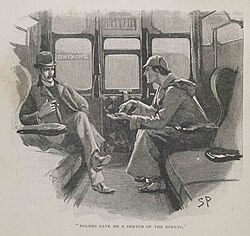
    Here’s the surprise: Arthur Conan Doyle never named it. In “The Boscombe Valley Mystery,” Holmes boards a train in a “close-fitting cloth cap.” In “Silver Blaze,” Watson mentions an “ear-flapped travelling-cap.” That’s as close as the text gets.

    The deerstalker came from the illustrator Sidney Paget, whose drawings for The Strand Magazine in 1891 put Holmes in the hat and an Inverness cape. It was a sensible choice, because the story takes him to the countryside of Herefordshire.

    The deerstalker began as sporting gear, with peaks to shade the eyes and flaps to guard against wind and cold, and tweed was the fabric of the Victorian hunting moor. It was country gear, not city wear, but the look stuck. Later artists put Holmes in it in London too.

    Then the stage took over. William Gillette played Holmes for decades, and the printed page and the footlights kept feeding each other until one image was fixed in the public mind.

    The hat outgrew its origins, and today it says “detective” even with no detective inside it. The image that lasted came from what was drawn rather than what was written.

    You can see William Gillette pretending to be Holmes in full costume, deerstalker and all, in Holmes for the Holidays, November 20, 21, 22 and November 27, 28, 29 at Roswell Community Little Theatre. Tickets are at roswelltheatre.com.

  • Got Game?

    From the hunt to Shakespeare, Sherlock Holmes, and Ken Ludwig, and now to Roswell Community Little Theatre

    The saying “the game’s afoot” begins with a hunt. In hunting, “game” means the animals pursued, and “afoot” means up and moving. Release the hound. Commence pursuit. The phrase carries physical energy: the quarry is on the run, and the chase has begun.

    Shakespeare Turns the Hunt into Battle

    William Shakespeare gave the expression its first memorable form in Henry V. In Act 3, Scene 1, King Henry rallies his soldiers before the assault on Harfleur:

    I see you stand like greyhounds in the slips, Straining upon the start. The game’s afoot! Follow your spirit…

    By comparing his soldiers to greyhounds in the slips, Shakespeare pictures them as sleek, powerful hunters held back at the starting line and straining for release. Warfare becomes a hunt, and the “game” becomes a contest of speed, courage, discipline, and desire. The metaphor gives his audience a heroic view of battle.

    The phrase makes two movements at once: the literal rush of the dogs, and the imaginative leap by which one human activity becomes another. Hunting becomes battle. The language of pursuit gives the soldiers a sense of purpose and gives the audience a picture of war as theater: the hounds strain, the signal comes. Sound forth the battle cry.

    Once more unto the breach, dear friends, once more;
    Or close the wall up with our English dead.

    Sherlock Holmes Turns the Hunt into Detection

    Three centuries later, Arthur Conan Doyle shifted the phrase again. In the Sherlock Holmes stories, the hunter is no longer a king leading an army but a detective following evidence. In “The Adventure of the Abbey Grange,” Holmes wakes Watson with an urgent command:

    “Come, Watson, come! The game is afoot. Not a word! Into your clothes and come!”

    Holmes commands, and the reader wakes, the battle-cry sounds. But the quarry has changed. Instead of an animal or an opposing army, Holmes hunts an explanation. His trail is made of footprints, fingerprints, inconsistencies, gestures, timelines, and overlooked details. His intellect is the hound released from the slips.

    Holmes also changes the logistics of the hunt. He is after more than a perpetrator; he is after revelation, the hidden truth. Every quarry leaves traces behind, and those clues form the trail. In this sense, Holmes turns hunting into a form of reading: he follows the trail not by instinct alone but by interpreting evidence.

    Holmes inherits Shakespeare’s excitement, urgency, and theatrical command, and redirects them toward mystery. The battlefield becomes London, the enemy becomes a criminal, and the charge becomes an investigation. The phrase still announces pursuit, but now the pursuit is intellectual.

    Ken Ludwig Turns Detection into Theater

    Ken Ludwig carries the phrase one step further in The Game’s Afoot; or Holmes for the Holidays. The play is set in 1936 and centers on William Gillette, the Broadway actor famous for playing Sherlock Holmes. Gillette invites his fellow cast members to his Connecticut castle for a holiday gathering. When one of the guests is murdered, he takes on the persona of Holmes and sets out to find the killer. The play was first presented by Cleveland Play House in 2011 and won the Edgar Award for Best Mystery Play of 2012.

    Ludwig’s version is not simply another mystery borrowing a familiar phrase. It is a play about the performance of mystery itself. The hunter is now an actor playing a detective created by a writer who had already inherited Shakespeare’s language. The phrase has traveled from the field to the battlefield, to the detective’s study, and onto the stage.

    That layered history gives the title its comic power. Gillette is not Sherlock Holmes, but he knows how to perform him: the gestures, the voice, the confidence, the habits of deduction. When a real murder occurs, the persona becomes unexpectedly useful, and dangerous. The audience is left to wonder where acting ends and investigation begins.

    The Pursuit Continues

    The line from hunter to Shakespeare to Holmes to Ludwig is a history of changing targets. The hunter pursues an animal. Shakespeare’s soldiers pursue victory. Holmes pursues truth. Ludwig’s actor pursues a murderer while also pursuing the question of what it means to play Holmes. At every stage the phrase keeps its original momentum: something has escaped, something must be followed, and whoever recognizes the movement must act.

    “The game’s afoot” survives because it is more than a quotation. It is a small dramatic mechanism that tells us the waiting is over. The dogs are released, the troops are advancing, the clues are beginning to connect, and the curtain is rising. The phrase has moved from the hunt into literature, from literature into popular culture, and from popular culture back into the theater. Its meaning changes, but its essential promise stays the same:

    The pursuit has begun.

    Join Roswell Community Little Theatre for The Game’s Afoot; or Holmes for the Holidays opening November 20, 2026, at Roswell Community Little Theatre. For more information, to join our “games leading up to the performance, and to buy tickets go to roswelltheatre.com.

  • Wonderland of Past and Promise

    (Note: I originally published much of this article in Roswell Now Magazine through the Roswell Chamber of Commerce.)

    Stepping through the doors of Roswell Seed Company is like stepping into a wonderland where Roswell’s rich history and promising future collide. Even the most recalcitrant among us can’t help but dream when confronted with the decades-old seed shelf and its rows of colorful seed packets adorning the front of the wooden drawers. From the commercial farmer to the windowsill gardener, there is something for everyone. We find hope, wonder, and industry in one fabulous store.

    John and Walter Gill opened Roswell Seed Company in 1898 as a produce company, buying produce from the fertile Pecos valley and selling it in Oklahoma or further east. John Gill would walk through an apple orchard or field of onions and offer a flat rate for that year’s harvest. From those early beginning as a produce market to the present store, the Gills have operated the business with an unusual mix of kindness and experience. One customer may come in with a problem in a backyard tree, while the next has 120 acres of seed they’ve captured, saying they need it cleaned and processed. Sometimes they need the seed stored for the following year’s planting. Regardless of the size of the account, every customer is treated with care backed by over 100 years of the Gill family’s experience in agriculture.

    Still a family owned and managed store Roswell Seed keeps the window of honor for local youth sports sponsorship. They donate to schools with projects in agriculture and gardening and have even favored local efforts in the arts with donations and support. I understand they may even have access to Uncle George’s hidden suitcases promoting the current production for Roswell Community Little Theatre.

    At the original publication of this article, Roswell Seed Company was known as the oldest family-owned business in New Mexico. But Jim Gill was careful to mention that there may be similarly long-lived family businesses that we just didn’t know about. Jim’s great-grandfather, John B. Gill, came from Arkansas to New Mexico in 1890. Jim would tell you with a mischievous grin that his great-grandfather settled in Hagerman because that was where the “nice” people lived.

    John Gill was an apple orchardist. When he came to New Mexico, he intended to continue working with apples. In the late 1800s, the Roswell area had many fine apple orchards. John Gill could walk through an orchard and tell how many boxes of apples the orchard would produce. John would then offer to buy the harvest according to this calculated production and would seal the deal with the grower using a handshake and a silver dollar. It was a binding contract, and growers were never mistreated. John’s word was stronger than any written document.

    Jim Gill shared the story of his great-grandfather learning about business in those first years. John packed a boxcar full of apples for a customer, but when the apples arrived at their destination, the customer had changed his mind. From that day on, John would “hitch” a ride in the caboose of the train and accompany his apples. If the customer didn’t take the entire load, or if John thought there was a market elsewhere, John would sell the apples directly from the destination.

    Originally the store stood on the corner that Ancient’s of Days now occupies. Roswell Seed Company has survived two world wars, The Great Depression, more wars and economic crises.

    According to family history, John Gill started the store with five hundred dollars in the 1890’s. Back then Roswell Seed and Produce was a grocer and a seed store. Today, Roswell Seed also sells garden plants, flowers, fertilizers, and bee packages. But what the home gardener and commercial farmer most appreciates is the wealth of experience, up-to-date information, and professional care that the staff offers. From guidance on reviving an ailing garden plant to cleaning and processing seed, Roswell Seed Company consistently advises based on a century of experience and continued zeal for agriculture.

    Among the many wonders in the store, if you manage to peek into the Gills’ office, you will see an old mantle clock still working. In a time before computers and wristwatches, Jim’s grandfather would step out the back door on a Sunday to see the train arrive and set first his pocket watch and then the mantle clock. Folks in Roswell counted on the clock at Roswell Seed to know the time. The people of Roswell continue to count on Roswell Seed Company. Through the store, the Gill Family has faithfully stewarded agriculture, the Roswell business community, and the people of the Roswell area.

    Even if you aren’t a gardener or farmer, come into this store for a taste of wonder and a look at how a business with a lot of history and heart can truly serve a community.

  • Book Review, In Search of the Hidden Moon, Tim Eichenbrenner


    In Search of the Hidden Moon is Tim Eichenbrenner’s second novel. The book takes the reader on a well-crafted hunt for right living through Christ even as the reader plunges into the darkness of human trafficking, failed marriages, failed parenting, and aging in America. Notwithstanding these lofty topics, the book maintains a humane tone, never overloading the reader with preach and teach dialogue, or mini sermons in case the reader doesn’t get the point. None of that. Instead, the voice is conversational and comfortable, so much so that I was sad to be at the end.

    The protagonist, Gil, is a doctor, but don’t let that stop a reader. Medical terminology is used in context and easy to follow and Gil is full of life and full of flaws. In short, he is easy to spend time with, as is his love interest, Alex. They navigate waters of relationships with charm and even grace. These two are engaging friends to the reader by the end of the book.

    The central plot is a wonderfully readable tangle that starts with an explosion, fire and dying man’s injunction to “find the girls.” Mixed in are minor plots of finding a unknown brother, second chances from a lackluster father, and a cheating husband, along with a very pastoral pastor. And dogs, did I mention dogs? Oh my, put a good canine in a book and I’m sunk and this book has several magnificent beasts.

    Read this book to make new friends, human and canine. Read this book for the great examples of forgiveness. Read it for the grace of the characters and the struggle for all of us living in this worldly world when our home is not of this world.

    Thank you, Tim Eichenbrenner for a great read. Find Tim at timeichenbrenner.com. He posts Tuesdays Thoughts on -wait for it- every other Tuesday. You’ll also find information on his first book, To Live in the Light: A Life Renewed, a Faith Restored.