Category: General

  • The Hat Sherlock Holmes Never Wore (According to Conan Doyle)

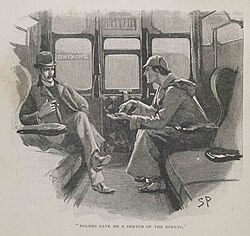
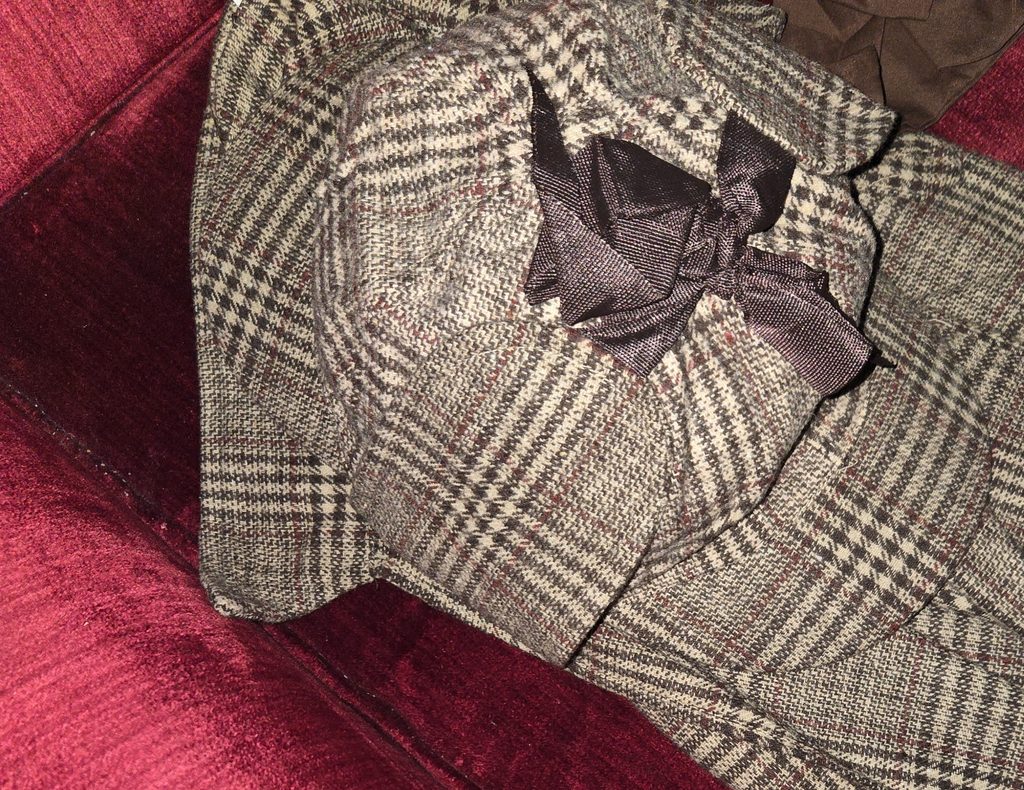
    Picture Sherlock Holmes. You’re almost certainly seeing a deerstalker cap, a tweed hat with a brim at both ends and flaps over the ears.

    Here’s the surprise: Arthur Conan Doyle never named it. In “The Boscombe Valley Mystery,” Holmes boards a train in a “close-fitting cloth cap.” In “Silver Blaze,” Watson mentions an “ear-flapped travelling-cap.” That’s as close as the text gets.

    The deerstalker came from the illustrator Sidney Paget, whose drawings for The Strand Magazine in 1891 put Holmes in the hat and an Inverness cape. It was a sensible choice, because the story takes him to the countryside of Herefordshire.

    The deerstalker began as sporting gear, with peaks to shade the eyes and flaps to guard against wind and cold, and tweed was the fabric of the Victorian hunting moor. It was country gear, not city wear, but the look stuck. Later artists put Holmes in it in London too.

    Then the stage took over. William Gillette played Holmes for decades, and the printed page and the footlights kept feeding each other until one image was fixed in the public mind.

    The hat outgrew its origins, and today it says “detective” even with no detective inside it. The image that lasted came from what was drawn rather than what was written.

    You can see William Gillette pretending to be Holmes in full costume, deerstalker and all, in Holmes for the Holidays, November 20, 21, 22 and November 27, 28, 29 at Roswell Community Little Theatre. Tickets are at roswelltheatre.com.

  • Deerstalker and Holmes

    The Man Who Made Sherlock Holmes Famous Before the Movies

    Before anyone said “deerstalker” and “Holmes” in the same breath, there was William Gillette.

    Gillette was an American actor and playwright from Hartford, Connecticut, and in 1899 he brought Sherlock Holmes to the stage. He wrote the play himself, with Arthur Conan Doyle’s permission. Legend has it that when Gillette asked whether he could marry Holmes off in the script, Doyle cabled back that he could marry him, murder him, or do whatever he liked.

    Gillette didn’t just play Holmes, he defined him. His sharp profile became the model for the illustrator Frederic Dorr Steele’s Holmes in Collier’s. He is also traditionally credited with the curved pipe, which he could keep in his mouth while delivering lines. He played the part well over a thousand times across roughly three decades, and for many theatergoers he was Sherlock Holmes.

    His life was as theatrical as his work. He built a castle on the Connecticut River, with hidden rooms, secret mirrors and a miniature railroad, and he lived in it like a man who never quite left the stage.

    That castle is where our story begins. In Ken Ludwig’s The Game’s Afoot, or Holmes for the Holidays, Gillette invites his fellow cast members to a Christmas Eve weekend at his castle, where a murder soon turns the party into a real-life mystery. The man who played the detective has to become one.

    Holmes for the Holidays runs November 20, 21, 22 and November 27, 28, 29 at Roswell Community Little Theatre. For more information and tickets go to roswelltheatre.com.

  • OPERATION EXCALIBUR A novel by Alethea Hartwell

    Hartwell creates suspense in a pre-World War setting.

    Operation Excalibur, a new work of historical fiction by Alethea Hartwell, tells the story of Rudolf Diesel, inventor of the diesel engine. The book examines the mystery surrounding Diesel’s death. Although Diesel was reported to have died by suicide, Hartwell offers another possibility—one that turns a familiar historical conclusion into an enjoyable narrative of suspense and intrigue.

    The novel’s voice is clear and easy to read. The reader understands complex ideas without losing interest in the storyline. Hartwell’s research and attention to historical details create a vivid portrait of time and place. The reader experiences the settings and ambiance of bygone days along with the heart-pounding realities of pre-World War I Europe.

    Rudolf Diesel pulls the reader into a bygone era.

    Hartwell creates an interesting character in Rudolf Diesel. She portrays him as a thoughtful, compassionate, and unusual man with deeply held beliefs about how life should be lived. Diesel knew and befriended many historical figures, and Hartwell does not shy from including them in the book. These were captains of industry and invention. Hartwell gives us a fresh perspective without hammering the reader on the perceived ills of past practices. Hartwell also makes clear where the demands of fiction have required changes to facts, dates, or chronology; a welcome consideration for readers who value both imagination and historical accuracy.

    Taking place just before World War I, Operation Excalibur explores an era less frequently portrayed than the familiar landscape of World War II fiction. That choice gives the novel a distinctive atmosphere and opens a window onto a world poised at the edge of enormous change.

    The book’s sensory descriptions highlight the novel. The reader feels the rain, smells the air, sees the sidewalk, walks beneath the lights, and hears the rumble of trains along the platforms. We stand at the ship’s prow, enter the lecture hall, and rise in a balloon. These are not merely backgrounds for the action; they are places we inhabit. Hartwell’s writing grants the reader a repast in history and, for a time, we are truly there.

    For readers who enjoy immersive historical fiction, real-life mysteries, and richly drawn characters, Operation Excalibur is a rewarding offering.

    (A.I. assisted in drafting the review, but the ideas and reading were all mine, along with the final draft. Thanks for reading. B.A. Coots)

    Alethea’s book is available directly from aletheahartwell.com

  • Wonderland of Past and Promise

    (Note: I originally published much of this article in Roswell Now Magazine through the Roswell Chamber of Commerce.)

    Stepping through the doors of Roswell Seed Company is like stepping into a wonderland where Roswell’s rich history and promising future collide. Even the most recalcitrant among us can’t help but dream when confronted with the decades-old seed shelf and its rows of colorful seed packets adorning the front of the wooden drawers. From the commercial farmer to the windowsill gardener, there is something for everyone. We find hope, wonder, and industry in one fabulous store.

    John and Walter Gill opened Roswell Seed Company in 1898 as a produce company, buying produce from the fertile Pecos valley and selling it in Oklahoma or further east. John Gill would walk through an apple orchard or field of onions and offer a flat rate for that year’s harvest. From those early beginning as a produce market to the present store, the Gills have operated the business with an unusual mix of kindness and experience. One customer may come in with a problem in a backyard tree, while the next has 120 acres of seed they’ve captured, saying they need it cleaned and processed. Sometimes they need the seed stored for the following year’s planting. Regardless of the size of the account, every customer is treated with care backed by over 100 years of the Gill family’s experience in agriculture.

    Still a family owned and managed store Roswell Seed keeps the window of honor for local youth sports sponsorship. They donate to schools with projects in agriculture and gardening and have even favored local efforts in the arts with donations and support. I understand they may even have access to Uncle George’s hidden suitcases promoting the current production for Roswell Community Little Theatre.

    At the original publication of this article, Roswell Seed Company was known as the oldest family-owned business in New Mexico. But Jim Gill was careful to mention that there may be similarly long-lived family businesses that we just didn’t know about. Jim’s great-grandfather, John B. Gill, came from Arkansas to New Mexico in 1890. Jim would tell you with a mischievous grin that his great-grandfather settled in Hagerman because that was where the “nice” people lived.

    John Gill was an apple orchardist. When he came to New Mexico, he intended to continue working with apples. In the late 1800s, the Roswell area had many fine apple orchards. John Gill could walk through an orchard and tell how many boxes of apples the orchard would produce. John would then offer to buy the harvest according to this calculated production and would seal the deal with the grower using a handshake and a silver dollar. It was a binding contract, and growers were never mistreated. John’s word was stronger than any written document.

    Jim Gill shared the story of his great-grandfather learning about business in those first years. John packed a boxcar full of apples for a customer, but when the apples arrived at their destination, the customer had changed his mind. From that day on, John would “hitch” a ride in the caboose of the train and accompany his apples. If the customer didn’t take the entire load, or if John thought there was a market elsewhere, John would sell the apples directly from the destination.

    Originally the store stood on the corner that Ancient’s of Days now occupies. Roswell Seed Company has survived two world wars, The Great Depression, more wars and economic crises.

    According to family history, John Gill started the store with five hundred dollars in the 1890’s. Back then Roswell Seed and Produce was a grocer and a seed store. Today, Roswell Seed also sells garden plants, flowers, fertilizers, and bee packages. But what the home gardener and commercial farmer most appreciates is the wealth of experience, up-to-date information, and professional care that the staff offers. From guidance on reviving an ailing garden plant to cleaning and processing seed, Roswell Seed Company consistently advises based on a century of experience and continued zeal for agriculture.

    Among the many wonders in the store, if you manage to peek into the Gills’ office, you will see an old mantle clock still working. In a time before computers and wristwatches, Jim’s grandfather would step out the back door on a Sunday to see the train arrive and set first his pocket watch and then the mantle clock. Folks in Roswell counted on the clock at Roswell Seed to know the time. The people of Roswell continue to count on Roswell Seed Company. Through the store, the Gill Family has faithfully stewarded agriculture, the Roswell business community, and the people of the Roswell area.

    Even if you aren’t a gardener or farmer, come into this store for a taste of wonder and a look at how a business with a lot of history and heart can truly serve a community.