by Bev | Jul 4, 2016
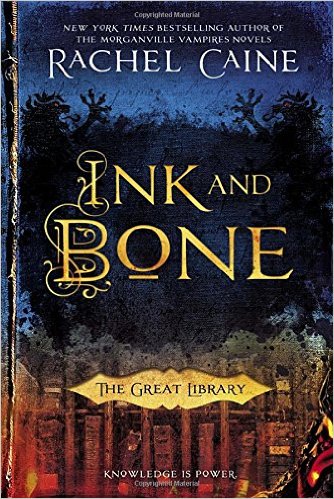 The sequel to Ink and Bone titled, Paper and Fire, comes out this week, so I thought a review might be timely.
Some have likened Ink and Bone to Harry Potter meets the Book Thief and even Hunger Games. I see the similarities, but I’m not quite there. I think Ink and Bone stands as a fresh approach, but lacking Rowling’s whimsy and magic or Zusak’s narrative voice, or Collins’ terse strength. I haven’t finished reading the Book Thief yet, so I may revise these comments later. I read some reviews of Ink and Bone that didn’t care for the opening, but I thought it dropped me into Rachel Caine’s novel in a compelling way and led me straight to the pivotal scene with the ink licker.
Usually, I quibble with a book about books, but this one worked well. It is a ‘what if’ fantasy that asks what if the Library of Alexandria never burned. What if the knowledge contained in the library served as the world’s currency and ownership of books containing that knowledge was forbidden? The world’s law and government are ordered through the Library and the Library watches and records every person’s life through electronic journals. Those who choose to abandon their journals and fight against the control of the library are branded heretics and burners often electing to set themselves and their journals on fire in a bid for the ultimate freedom of death.
The main character, Jess Brightwell, is the son of a book smuggler. Due to his father’s business, Jess has held and read many rare books and has an uncanny sense about them. Rather than follow in the family trade, Jess successfully tests and receives a berth at the Library’s training facility in Alexandria. Enter the school setting and the similarities with Harry Potter and a thousand other fantasies. This school tests many skills while imagining Alexandria in 2025 as the seat of global power with its library still intact and the people of the Library: Scholars, Guarda and Obscurists as legislators, law enforcement, imprisoned magical minorities who preserve absolute dominion of the Library.
I agree with one reviewer who noted that the story breaks down when we learn that all people have access to all books through their electronic journal. I did wonder what difference it would make if all written work was available electronically to all mankind. Only a single study was banned and removed from access; that being the repeated invention of the printing press. I liked the idea, but a more in depth look, something beyond the nature of light YA science-fiction fantasy, would probably ruin the story making it too cumbersome.
This brings me to my final pint (oh oops, perish the thought of a final pint) point. Rachel Caine does go the extra mile, so to speak in studying the effects of the printing press through the historical notes at the beginning of the chapter. These are rightly called Ephemera from the Greek meaning not intended to last the day, something not meant to be retained or preserved and definitely not preserved in the codex. In these we learn backstory and history and family connections. We read coded messages and learn the history of the resolute printing press, and its connection to major characters in the book, we also read of the corruptive nature of power in the twisted logic of the Library’s elite. Because of the Ephemera, I consider the book a bigger work and would re-read it. These notes in the front of the chapters cause me to think of politics over lives, worldly treasures over love, and re-writing history over truth. It’s a keeper. Thank you for reading and thank you, Rachel Caine, for writing.
Also posted on Goodreads, justonebeggar.net and writingroguesrant.blogspot.com
by Bev | May 31, 2016
 When the Mockingbird Sings, by Billy Coffey, 2013 Thomas Nelson
I purchased this book from a list of you-may-also-likes in an online retail browser. I bought it because it was one of the few Christian fiction releases I could also find in an audio-book. This review is based on first listening to the book and then reviewing the hardcopy. It is the first book I have read by this author. Hints William Faulkner’s terse characterizations, tastes of Mark Twain’s dialects, and the distance of Flannery O’Connor couple in When the Mockingbird Sings to suggest a Southern literary narrative voice.
The tells of Leah who sees and speaks to the Rainbow-man. She first sees him on her ninth birthday when the whole town is invited to the Leah’s house scarcely months after their father had moved the family from Camden to a dilapidated old Victorian mansion in the rural south. Another nine-year-old befriends shy, stuttering Leah and though no one else can see the Rainbow-Man, this friend, Allie, struggles to believe in the vision and likens him to Jesus, going so far as to Baptize the un-washed Leah in in an inflatable pool in Leah’s backyard late one summer night. It was one of the most charming scenes of the book and caused me to appreciate this author’s boldness and wit in a new light.
The Rainbow-Man coaches Leah to paint beautiful renderings far beyond her talent that illustrate glory, and then, warn Mattingly of a terrible fate. One of the paintings magically bears the winning lottery numbers which ultimately disappear from the painting. A former town patron who is under extreme financial strain, plays the numbers and wins, but the money will not save is dying wife. The ruckus further divides the town.
I have a weakness for well-defined setting where a town or community takes on a character. In this novel, Coffey turns the rural community of Mattingly into a single body, a flawed congregation with strict attention to doctrinal recipes, lovable in a way that a stubborn warrior is lovable when he cannot win but clings intractably to a bit of high ground – the cow standing on the manure pile. Mattingly shines as an allegory for the church and I couldn’t help but love her as the main character of this book, human scared and undiscerning.
Coffey also draws vivid characters and does not force them into a personal agenda. The characters speak for themselves, each an ‘everyman’ with a recognizable traits and troubles. While the characters show their fears and weaknesses, the author’s hand is never so heavy as to mock his own creations.
I’ve rated this book three stars because it is good, but just shy of an absolute keeper, meaning I probably won’t re-read it. While the language is occasionally poetic, the narrative voice is too harsh and the poetry is insufficient for this reader to make me we want to return to it. Overall the individual characters are so removed that I had trouble establishing a bond with anyone in the book. Most strongly I felt little for Rainbow-Man whom I so wanted to walk with.
This brings me to my final point, that of the Rainbow-Man as Jesus. Rainbow-Man is so enigmatic and cryptic that I couldn’t relate. I never grasped the indwelling of the Holy Spirit in any character in the book and certainly never in the character of Mattingly the town. I understand the concept of prophetic vision and God’s sovereign use of the weakest among us in enacting His plans. The author seems to suggest that Leah is such a prophet, but I never quite reached the same conclusion. I would add that the cryptic portrayal of Rainbow-Man did cause me several hours of contemplation on how much we take for granted in our Sovereign, and how we often choose to dwell on His capacity as Comforter and Perfect Father rather than His almighty power.
Pick up When the Mockingbird Sings for a refreshed take on corporate character in the town of Mattingly. Delve into it for an engaging story.
Thank you for reading, Bev.
by Bev | Jun 5, 2015
Where is your favorite thoughtful spot 62 of the World’s Most Beautiful Libraries | Mental Floss http://ow.ly/NSDUg
 I am a mother, author, engineer, farmer, occasional actress, and incurable dog-sap. I think things and write things and embarrass myself often.