Lynetta Zuber has been in theater since she could talk. Her next play is a musical, She Loves Me, and Lynetta has directed, designed sets and choreographed and has a role in the performance.
Lynetta began in Christian drama at her church and has been a student of theater ever since. If there is a need in theater, Lynetta learns to fill the need. She is effective at lights and sound, props and set design.
Lynetta enjoys working with children and has been instrumental in shifting the Roswell Kids in Arts Program to Roswell Community Little Theatre, (RCLT). Lynetta takes pleasure in seeing her students learn and grow in a productive way.
Lynetta is a talented performer both with a script and in improv. She is a pleasure to work with on and off stage. She works hard to make performances go smoothly whether on stage or behind the scenes.
Lynetta prefers wholesome fun works when proposing a script, and she delights in the challenge of choreography along with set design. Her next play offers all of the above. It is wholesome and fun, with wonderful sets and great choreography. The play is a musical that is just right for RCLT.
Come and see She Loves Me, opening August 13th and 7:30 at Roswell Community Little Theatre, with six performances: August the 12th, 13th, and 14th, and again August 19th, 20th and 21st. The Friday and Saturday shows begin at 7:30 p.m. and the Sunday performance is at 2:30 p.m. We'll see you at the theater.
Kathy Cook grew up in Roswell, graduated from Goddard and received her Music Education degree from Wayland Baptist University in Plainview, Texas.
Kathy married and had two children and taught for eleven years before going back to school for vocal performance. Kathy’s specialty was in operatic performance, and she spent a summer in Austria with the American Institute of Musical Studies. In Austria, Kathy learned what opera houses wanted which made her a much better teacher in her field.
Kathy began in theater when she was seven years old. Later in high School she began directing as rehearsal accompanist. She continued directing throughout college. She never tries to top a previous production but strives to make each production the best it can be.
Kathy is directing the current production at Roswell Community Little Theatre. She has put together a fabulous cast of old hands and new faces. The play is rich with humor, slapstick, puns, and belly laughs. The set is remarkable and adds to the fun of the production as the cast moves room to room to solve the mystery.
If you’re a fan of the game Clue, or the movie, Clue, or just wanting a great night out full or laughter, don’t miss Clue: On Stage. May 6th, 7th, 13th, and 14th at 7:30 p.m. and May 8th and 15th at 2:30 p.m. at Roswell Community Little Theatre.
Moving with his military family, Randy Nolan grew up in Germany, Texas, and North Carolina. Randy is a proud father and a husband to his wife who was an Olympic athlete in volleyball. Following the family tradition of military service, Randy is a Navy chaplain and now interim pastor at First Presbyterian here in Roswell, NM.
Randy began his love of community theater in high school while living in El Paso Texas, where he was cast in Royal Hunt of the Sun. But he had been acting and enjoying the theater since the first grade. He played the White Rabbit in Alice in Wonderland at the ripe old age of six. Since then, he has been in over fifty shows and worked with over twelve different theaters.
Early on he admits to being drawn to theater to meet girls. Soon he grew to enjoy being on stage, hearing the laughter and applause. He claims he basically played himself in, You’re a Good Man Charlie Brown, and laughs remembering a line in the play. “You were born to play this part."
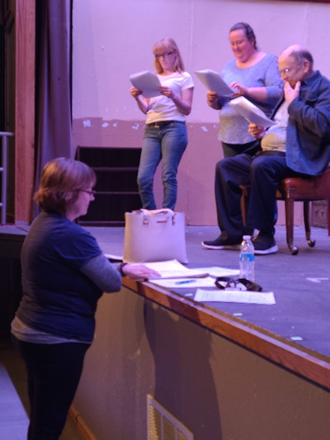
Rehearsal for Clue: On Stage
Randy recalls a role in George Bernard Shaw’s Major Barbara, where he had to stand for 45 minutes without acting. It was difficult to say the least. While performing in Avalanche at El Paso, one cast member kept showing up drunk and Randy had to think quickly and learn to ad lib.
One of Randy’s favorite memories is playing the “ugly and wizened,” Judge Wargrave in Agatha Christie’s And Then There Were None, sometimes known as Ten Little Indians. Randy remembers being boo-ed every night at curtain call and said playing a “bad guy” was tremendous fun.
In his latest role in Clue: On Stage, Randy dies again and again.
Come see Randy in Clue: On Stage, opening Friday May 6 There will be six shows: May 6 and 7 at 7:30 p.m. and May 8 at 2:30 p.m. also May 13 and 14 at 7:30 p.m. and May 15 at 2:30 p.m. in Roswell Community Little Theatre. For more information go to: https://roswelltheatre.com/events/clue-on-stage/
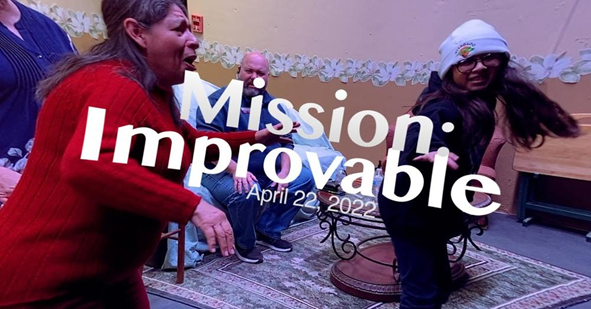
Thanks to Alethea Hartwell and her passion for improv, Mission Improvable is coming to you again live April 22nd at the Roswell Community Little Theater (RCLT). The show begins at 7:30 p.m.
In a recent interview, Alethea says that the skills an actor learns in improv are so applicable to daily life. She describes three principles that actors focus on as they learn improv. and how those skills can translate into healthy relationships and better life.
The first principle is, “yes and.” Working with actors in improv, a simple “yes,” carries the story forward. A “no,” can stop the momentum and sometimes even the story element of the improvisation. Add the “and,” to the yes and momentum and story increase. Alethea makes the case that in life relationships may be strengthened by agreement where possible and adding the “and,” is adding encouragement.
The second principle is: “Always make the other person look like a genius.” In a performance this brings out the best in the troupe, in life it brings out the timid, helps raise the conversation from derision to joy and solicits a person’s best response.
Alethea spoke of one final principle: “Practice active listening.” On stage, active listening sharpens the storyline and allows people to drop into the imagined scene more easily. The whole troupe is more confident in proceeding. In life, active listening strengthens healthy relationships and is the foundation of compassion.
Of course, improv is fun and full of laughter, so come and see the show.
Improv Rehearsal
Next up for Alethea? She has been cast as Miss Peacock in Kathy Cook’s latest play, Clue: On Stage. Alethea is a fabulous comedic actor, and this play has ample places for her to shine. Kathy Cook has assembled a wonderful cast and they are hard at work in rehearsals.
If you’re a fan of the game Clue, or the movie, Clue, or just wanting a great night out full or laughter, don’t miss Clue: On Stage. May 6th, 7th, 13th, and 14th at 7:30 p.m. and May 8th and 15th at 2:30 p.m. at Roswell Community Little Theatre. For more information, click on the image below.
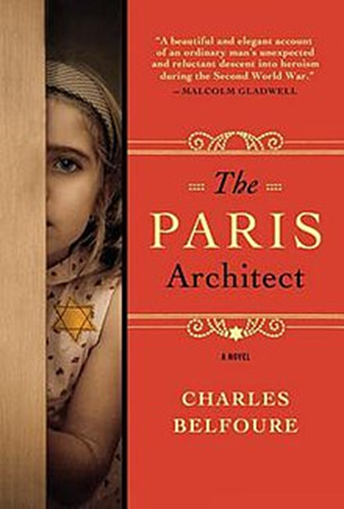
The Paris Architect, by Charles Belfoure is set at the time of World War II in occupied Paris. The main character, Lucien Bernard, is an architect in desperate need of work. Lucien is on his way to interview for a position with a wealthy industrialist Auguste Manet. Manet is building munitions factories and plants for the Reich.
In the opening scene of the book a German Officer shoots a Jew on the streets of Paris. Lucien is so close that the blood spatter from the shot gets on Lucien’s only good suit. The reader doesn’t know what branch of service the German officer serves only that his uniform is green and black.
The Paris Architect, teaches the reader in the first pages of the book. The reader learns that the German soldiers are ruthless but polite, Lucien has little or no concern for the fate of the Jews, Lucien cares more about his clothes than the dead man, and he cares more about presenting a calm confident air to Manet.
The opening is startling, brutal, and plays fair with the reader and the main character of the book. It is a satisfying opening and the reader is prepared for violence and the upside-down world of politeness in the face of evil.
In subsequent chapters Lucien is hired to work on the design and construction of munitions factories for the Reich only after agreeing to design hiding places in plain sight for refugee Jews. Both of these out of synch requests come from the wealthy industrialist Auguste Manet.
The premise that a great industrialist with such talented carpenters, draftsmen, and builders at his disposal should bother with an architect for his plans to hide Jews didn't ring true. The construction technicalities of that effort were never developed and might have been used to deepen the characterizations as well as make more believable and intense that narrative. The noise, the deconstruction and reconstruction, getting supplies into buildings and debris out of buildings right under the Reich's nose, all of this would have gone a long way to making this a strong re-readable novel for many readers.
Belfoure’s field of study is architecture and real estate with a specialty in historic preservation. Belfoure studied the Priest Holes of 16th century England and began thinking of a plot which became The Paris Architect. The priest Holes of England are a fascinating study and would have made a remarkable work of historical fiction. In translating the circumstances of England’s hiding holes to Paris during the Occupation, Belfoure loses depth and character. He trades a real situation for an inserted fiction. He also trades the real character of the carpenter Owen, for the shallow fictitious character of Lucien. Finally, Belfoure also trades a lesser understood setting with wonderful pathways for fictionalization for a setting with choices that are too easy and simplistic for heightening tension and plot. Belfoure makes little attempt at showing us the actual hiding places, how they are built, who is in on it. Being with Lucien as he sees his piano hinge going into place and the difficulties of actually fitting that hinge would have made for strong characterization of Lucien. Belfoure adequately explains that Lucien wants little or nothing to do with the actual construction, but it leaves a false ring in the explanation's wake. The hiding places of The Paris Architect magically appear by magical carpenters within hours of receiving a set of drawings that equally only took hours to prepare. The lack of details left the book sagging a bit in the middle and Lucien’s character flat. To read an alternate point of view read Ar. John McLean’s in depth and thoughtful review. https://johnmcleanarchitect.com/the-paris-architect.htm.
The book takes a nice turn in the end when Lucien connects with Bette and adopts Pierre. The final scenes were satisfying, and Lucien finally grew into an ethical character. Major Dieter Herzog is a minor character with an important role in the book. His character was well rounded and after finishing the book, it is worth effort to revisit the scenes he occupies.
Read this book for a satisfying fast paced read of WWII fiction. Read it for the transformation of Lucien in the end and read it for the minor characters of Dieter Herzog and Pierre. Thanks for reading.
The back cover of this book reads, “an unforgettable love story, but it is not the one you’re expecting.” The book blurb plays fair with the reader. In Five Years isn’t a romance by any stretch of the imagination. This book covers a friendship as a love story. Serle develops two female characters who lean on each other from their grade-school days and struggle through professional and personal griefs and triumphs. Serle’s evocation of the friendship between Dannie and Bella is one of the reasons to read this book.
In Five Years begins with a perfect couple planning their perfect life in a completely predictable manner. David and Dannie are settled and happy. They are not in love, but they love each other. In fact, Dannie, in the first pages of the book, is charmingly well organized and analytic and supremely unconcerned about the goo of relationships. She is a colorful mix of the Big Bang Theory’s Sheldon and Joan Hickson’s rendition of Miss Marple. Dannie is not much for emotions, unlike her best friend Bella. Dannie is all about work, schedules and doing what’s next in her plan. She presumes that her mate David is on the same path and equally comfortable. By the end of Chapter two, Dannie and David are engaged and celebrating. Bella is in the loop cheering Dannie on.
In chapter three, Dannie has a short dream/prophetic vision and the book changes course. The reader is supposed to take the prophetic vision seriously, but it is a difficult jump. The book is clearly not science fiction or fantasy fiction, so this prophetic vision never quite seats itself. Instead, the main character becomes an unreliable narrator. The switch to suspended realism in an otherwise down-to-earth book and with a particularly down-to-earth main character upends the groundwork already laid by the author in the first two chapters. The reader no longer knows how to read the book. To complicate matters, down-to-earth Dannie becomes a ‘hot mess.’ Remarkably she still performs her work to her very high standards even while her world is upside down.
Without spoiling the book for those who haven’t read it, the ending seems less real than the vision. It was set forth to solve the mystery of the vision with little heed to the characters.
The book is a quick read and the plot twists and turns in ways that keep the reader reading. It is not a book to return to, but the mystery is satisfied and the open ending works.
Read In Five Years for the characterization of Dannie and the crazy plot twists. Thanks for reading.









 I am a mother, author, engineer, farmer, occasional actress, and incurable dog-sap. I think things and write things and embarrass myself often.