by Bev | Mar 12, 2019
Prairie Fires
Written by Caroline Fraser, Prairie Fires is a biography of Laura Ingalls Wilder, her parents, grandparents and daughter couched in a history and discourse of the American frontier.
The biography finds purchase in the final third of the book, describing how the Little House books came about.
In most of the reviews I’ve read, Little House fans adored Prairie Fires. They cut their ‘reading teeth’ on Wilder’s books, many learning how to read from the Little House books along with how to accomplish many other frontier tasks. I don’t disagree that Wilder helped form the frontier conscience of our nation, but I think this was unwitting on her part.
Wilder was not my first read. In fact, my mother tried to get me to read the Little House books but I found the work tedious and too shiny. (Funnily enough, I found Prairie Fires tedious also.) I knew even at five and six years of age, that I was being forced to swallow the Pollyanna without much story. I just couldn’t find a footing in the books and if the books were bad the television series was deplorable. My tastes ran more to fantasy, which I knew wasn’t real and enjoyed it all the more for it. I mention all of this ‘me’ stuff because I am an unreliable reviewer for this book.
I admired Fraser’s research but became bored with her preaching about the sins of early American governments. This nation is an easy target and often exploited. But as a writer she is surely entitled to her own soap box. I just thought the book would have been a much better read without the discourse.
The other thing I took issue with was the pressure of the ‘truth.’ Wilder wrote rosy children’s books. I think it would be clear that she had help writing them and that she kept to the sunny-side of major tragedies. I see no reason to dive into Wilder’s past in order to state the obvious and be so exercised about it that countless references fill the book. Maybe this is unfair to Fraser who is a talented writer and remarkable scholar. Like I said, I am an unreliable reviewer.
So why read the book? If you are interested in the American frontier, read this book. Farser’s research is superb.
If you treasured Wilder’s series, read the last third of the book. It is a well detailed story, if a bit skewed against Rose. Perhaps Rose was a quarter bubble short of plumb. I am not so convinced in this telling, which seems to rely on Rose’s political views as much as other facts. But I did enjoy how Wilder developed her stories and her skills.
The final reason to read this book is to join the discussion which is full and rich and very American. Thanks for reading. Bev
Published also at Goodreads and http://www.justonebeggar.net/
by Bev | Aug 3, 2016
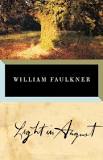 So a tiny brag, I usually stick to fun, light, genre fiction, the penny dreadful, but I try to read a bit of the hard stuff from time to time. Last month I listened to Light in August, read by Will Patton. Those of you who listen to James Lee Burke will know Will Patton’s talent for southern voice. So, yay me.
As I read through a few reviews and notes about the book I saw many wordy entries as if reviewers in their great respect for Faulkner’s work were trying to mimic him, some successfully but others, not so much. I’ll try to keep this brief.
Yes, it is Faulkner and even the title is poetic. In his Nobel acceptance speech, Faulkner ends by saying, “The poet’s voice need not merely be the record of man, it can be one of the props, the pillars to help him endure and prevail.” With this book, Faulkner achieves a quality of poetic prose that surely goes beyond simple record to speak to beauty and creation.
As a novel, rather than narrative poetry, Light in August is a multi-headed beast, partially sketching the stories of Lena Grove, Joanna Burden, Joe Christmas, the McEacherns, Lucas Burch, Byron Bunch, Reverend Gail Hightower, Doc Hines and several others. Faulkner tells of Lena’s pregnancy and her search to find the father of her baby who left when he heard of her condition. It tells of Joe Christmas an orphaned child who lives as a white man, but thinks he has black blood. The book images his struggle to accept his life and his search to silence his history. It tells of a Presbyterian minister and a Baptist minister, both failing for different reasons. They meet in Jefferson in Yoknapatawpha County.
Faulkner’s characters are beautifully imagined, but they remain on the page entrenched in a hopeless human struggle with little grace or true charity. They are almost caricatures, so firmly are they held by Faulkner’s pen. I noticed that, while the characters all meet, they scarcely interact. Their situations impact each other through the reader rather than through each other. The reader is distant from the characters and the characters are distant from each other.
While I wouldn’t call this Dark in August, I might consider the title separately. Faulkner describes the light in many places in this book, but I see the golden joy of August’s light differently. It is light that quickens the harvest, no longer as fierce as the sun of July. But if he had titled the book, the Fierce Light of July, it just wouldn’t have worked, accuracy notwithstanding.
As I mentioned earlier, I have read Faulkner before and enjoyed his rich voice, but I don’t remember the stories as much as the images and a sense of personal victory upon completing one of his books along with a desire to return to it at a later date.
Read Light in August for the poetry and the mastery of Faulkner’s rich voice. Read it to be drawn into grateful prayer for the Good News of Salvation.
Also posted on justonebeggar.net, Goodreads and writingroguesrant.blogspot.com
Thanks for reading BEV
 I am a mother, author, engineer, farmer, occasional actress, and incurable dog-sap. I think things and write things and embarrass myself often.